The suffering local music scene in San Diego
By Cameron San Agustin
December 2, 2025
Story Highlights
* Streaming music apps have changed the way many consume music today, impacting the local music scene in many ways according to Liz Pelly at the Guardian.
* Over the past decade at least eight smaller all-age venues have shut down in San Diego, making it hard for bands starting out to be a part of the local music scene.
* “I think we’ve been sold this idea where you have to prioritize social media, you have to prioritize streaming and you have to have good numbers on those two things,”Cameron Gates, drummer for the bands XING and Uppies, said. “If you prioritize that you have to spend x amount of hours a day writing, recording, producing content, editing content and promoting content and it’s so ego fueled too.”
SAN DIEGO – From the early 2000s to 2019, the San Diego music scene has had at least eight music venues close down. These venues included Title TK, The Irenic, Copa Cobana, Equinox and Gym Standard. These venues provided a place for local artists to perform to concert goers of all ages.
Lack of all-ages music venues
According to Listen SD, an organization that provides updates on local San Diego music, there are 24 major music venues in the city of San Diego today. Out of those 24 major music venues, only five of them are all ages. Two out of the five are mid-sized venues, appropriate for smaller local artists.
This map shows the amount of some of the music venues that have shut down in the past decade in the San Diego area. These venues are smaller, all-ages venues that weren’t a part of Live-Nation or pay-to-play. The venues are spread out all over the county. Some are in Lemon Grove, a couple in the North Park and City Heights, and others are in further areas like Mira Mesa and El Cajon. A lot of these venues were privately owned as well, meaning they were either a store front for something else or they were a D.I.Y venue that was built from the ground up. This map doesn’t represent all venues that have shut down in the past decade, just some of the ones that were major hot spots for music scenes based on this reporter's analysis and research.
Ricky Schmidt is a local musician in the bands RICKY, Braxton Hicks and Sister Freak. He has been playing around San Diego for over a decade while also having opportunities to go on full U.S. tours.
“It's cool being able to do the big all ages venues like that just for that reason, younger folks can come out to shows,” Schmidt said.
With the shutting down of smaller venues, the only venues that frequently host shows are 21 and up bar venues and larger venues that host bigger bands. Along with the closing of smaller music venues, music consumption on social media has been growing, but its impact is not all positive for local musicians.
Music streaming and social media effects on the local music scene
Spotify is the most popular music streaming app in the U.S. according to David Curry in the latest Music App Report. Music is now extremely easy to access, especially having algorithms catering to the listener’s preferences, but its easy access makes it difficult for any artist to stand out among the millions of artists that have their music on streaming apps.
“While listening to Spotify, you throw on a playlist and as its playing while your driving or doing chores, a song comes on that you like and your like oh that’s cool and you like and add it to your playlist, but you never go and look at who the artist or where they’re from or if they’re coming to town and playing,” Richard Dotson, bassist for The Frights and local sound engineer, said.
Along with over saturation comes passive listening habits. Since music streaming apps are so popular, passive listening is the main way people digest music. It’s not necessarily a negative thing, but it can also drive the lack of in person community that local scenes support.
“Back in the day man you would scour Bandcamp, you find the rabbit holes and go to a record shop and talk to somebody and figure out what they like and the overlaps and you would discover new music that way,” Cameron Gates, drummer for the bands XING and Uppies, said.
Social media has also affected the way people build communities online rather than in person.
“Nowadays I think a lot of artists see the path forward is online and they put all of their eggs in that basket,” said Dotson. “Like, okay, instead of playing every show we can, we need to make as many Reels and Tik Toks as we can.”
Going viral through social media can be important, but it can also create more passive listeners according to Music Mogul Marketing. With more passive listeners and online communities, the added factor that music can be a very expensive hobby can also negatively affect the local music scene.
Music is expensive
Being a musician can be expensive, and for those who are trying to make a living off of it though playing local shows, it can be impossible in an expensive city such as San Diego. It’s not just pay to play venues, ticket sales for live shows are down in general. Between 2023 and 2025, North American concert ticket sales for festivals and arenas have gone down with rising cost of tickets being one key factor according to the website, Concerts & Tickets.
“Even for medium to large bands, ticket sales are down,” said Dotson. “It’s not just a local thing, I think economically it’s pretty fucked currently and like every band is competing against Oasis and the average music lover only has X amount of dollars that they can spend on concert tickets every year.”
For bigger named artists, the nationwide average concert ticket can cost anywhere from $75 to $250. Dotson believes that since the average music listener would rather spend money on bigger named artists that come through San Diego than local artists.
Pay-to-play venues are another layer to the costs musicians have to endure.
Pay-to-play venues are places that charge smaller artists to put on an event. There are several ways they can charge the artist. One popular way is by offering the artist a certain amount of presale tickets that they have to sell personally. If they can’t sell all of them, they have to pay the remaining amount of ticket money to the venue. For example, if a small band were hosting a show at a pay-to-play venue, the venue would give them 20 presale tickets costing $10 each. If the band only sells seven tickets, then they would have to pay back the venue $130 since it is the amount of money that remaining tickets cost. While pay-to-play venues have always existed, the shutdown of several smaller venues around San Diego have left artists with limited options of pay-to-play venues to perform at.
In San Diego, major venues such as Soma or House of Blues are pay-to-play venues. These types of venues make it difficult for an artist to create a following, and with a lack of other smaller venues, the discouragement of having to pay venues to play them makes it that much more difficult to have a community surrounding it.
There are also expenses for musicians such as instruments and recordings that can discourage any musician.
For example, the cheapest acoustic guitar one can buy on Guitar Center's online shop is $79.99. This is without taking into account replacing strings roughly every month which cost $9.99 per pack. Musicians often like to upgrade equipment as they advance as well, meaning they are going to continuously buy more expensive gear. Other than the guitar itself, buying an amp can also be very expensive. The cheapest amp you can find on the Guitar Center online shop is a 1x8 in. Fender combo amp, costing 169.99. This is typically the cheapest amp a musician can buy, meaning an upgrade would be pretty necessary after two years of playing on it. Drums can range anywhere from $200 to $400 for beginners.
For musicians who are recording, recording music can also be very costly. For example, Capricorn studios in San Diego has an hourly rate of $80, $300 for four hours and $550 for eight hours of recording time. If a musician would like to record an album, which is roughly 8-12 songs, they would most likely need more than eight hours of recording time, spending over $550 dollars for a single album.
The future of the local music scene in San Diego
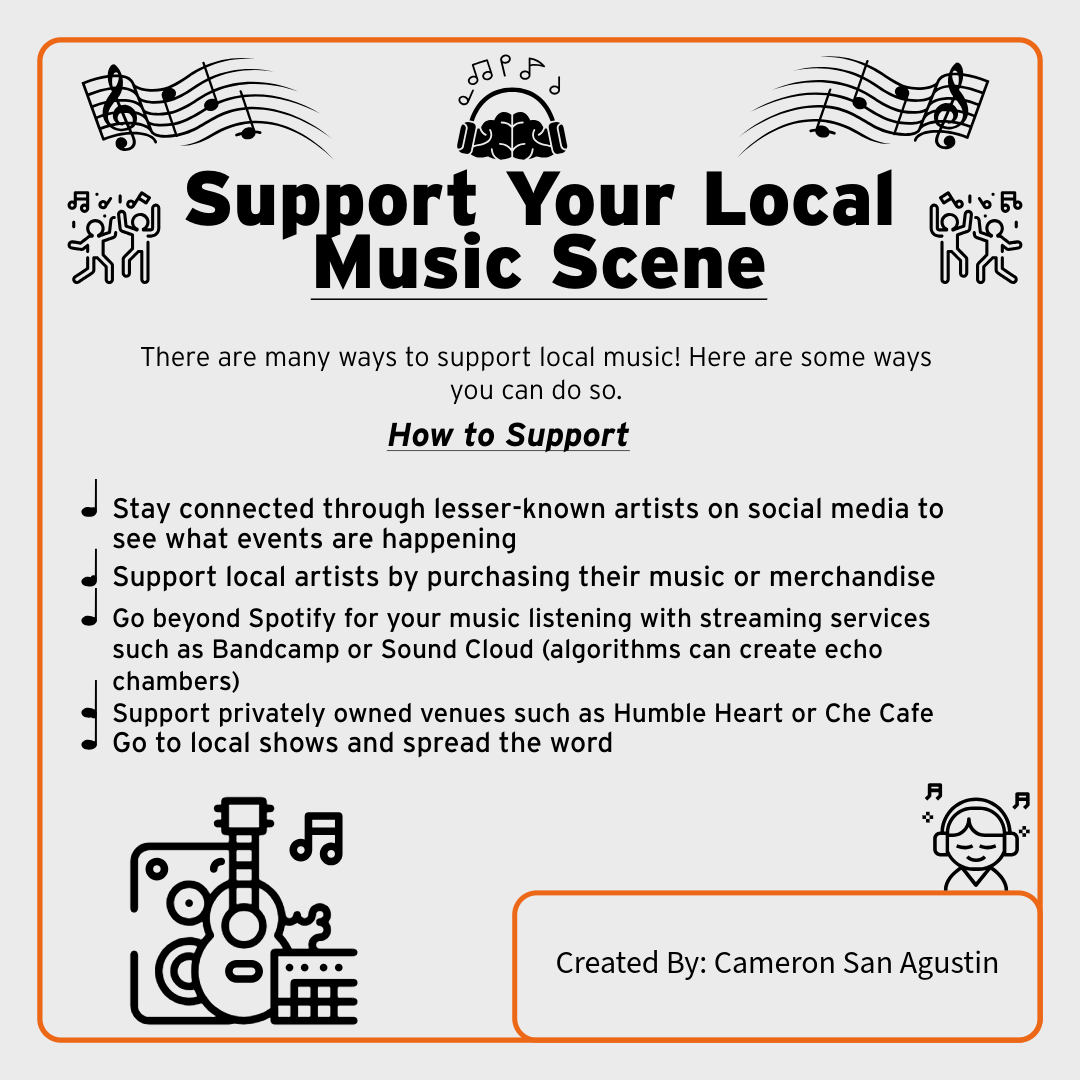
Streaming apps, lack of resources, pay-to-play venues and expensive equipment as well as studio time are some of the main factors as to why the local music scene can be suffering in San Diego, but the local music scene in San Diego is not dead. There will always be small pockets of artists who host shows through DIY events, either at house parties or at spaces for all ages such as the Che Cafe or Humble Heart.
There are multiple ways the community can support the local scene by connecting and staying up to date with local artists, or buying merchandise to support their art. Instead of Spotify, one can try finding music through record stores or online platforms like Bandcamp where you can have the option to send donations to artists.